
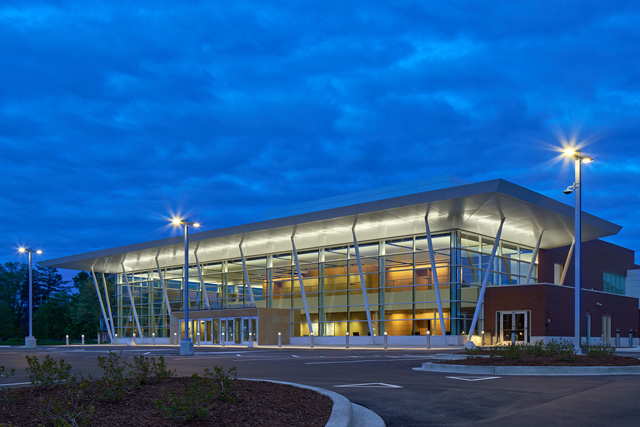
Last week we profiled another architect who was known nationally, yet not locally in Metro Detroit – Paul Rudolph. He came to Grosse Pointe in 1970 to create 3 Cameron Place for Dr. Frank Parcells. It was the only home he created in Michigan.
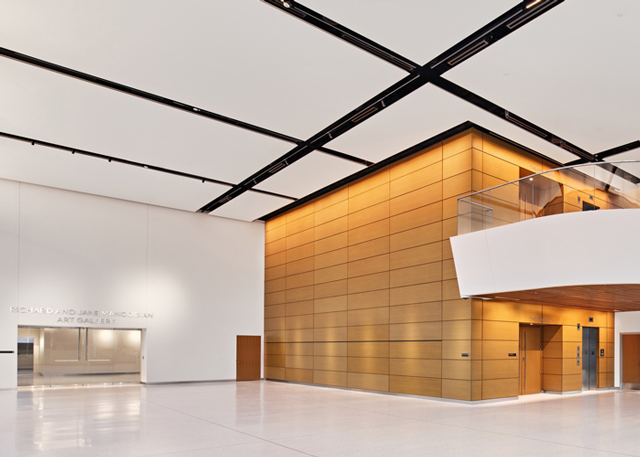
This week we stop by Grosse Pointes newest building, the A. Paul and Carol C. Schaap Center for the Performing Arts. This stunning structure opened a couple of weeks ago (May 2026) and is now welcoming guests to enjoy performances and art displays in the Richard and Jane Manoogian Art gallery.
The Building
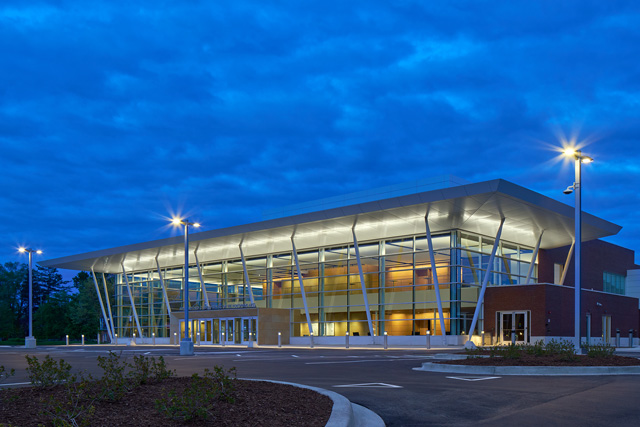
The Schaap Center is a world class performing arts center – it is 49,000 square feet, with 435 seats, state-of-the-art-lighting, world-class acoustics, and a temperature-controlled gallery. The design is bold and contemporary, yet respects the scale and materials found in the city. Mankato limestone frames the main entrance which is surrounded by a glass curtain wall consisting of high-efficiency, transparent low-e glass. Image courtesy of: Schaap Center
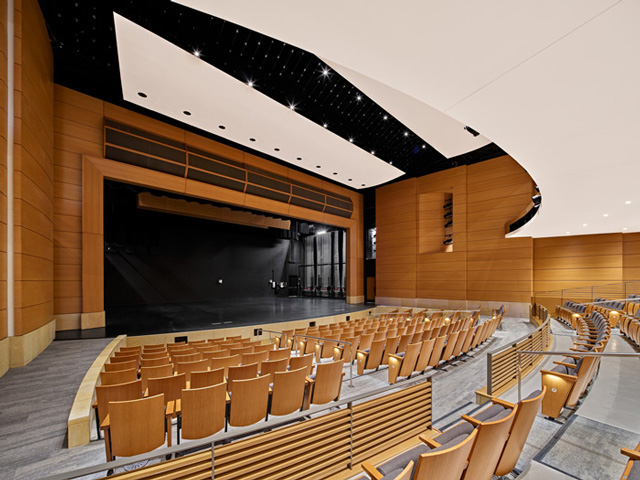
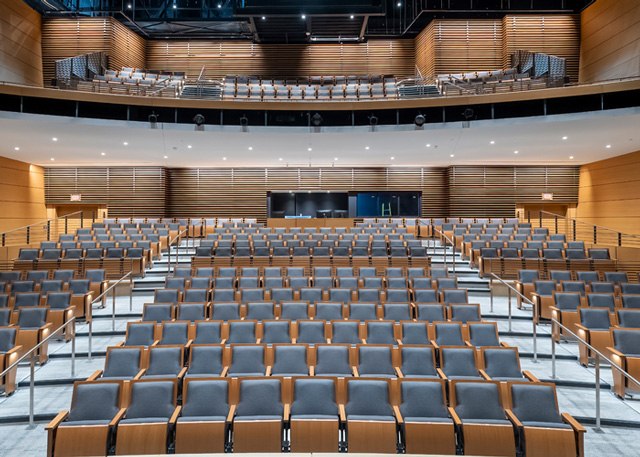
The structure is comprised of a performing arts hall, support spaces, a secured gallery, and a multi-purpose space used as a lobby, pre-function/gathering space, and community arts display. The theater will be used for productions as well as performances from several Metro Detroit based creative partners. The theater function is fully supported by various spaces befitting a world-class facility, with a full make-up, wardrobe, scene repair shop, green room, symphony room and various equipment storage rooms. The ceiling in the theater has a dark sky effect with large, acoustically engineered brushed metal cloud forms. The ambient and theatrical lighting is in gaps between the clouds – the lights can change color and appear in different patterns. Images courtesy of: Schaap Center
Exhibition Space
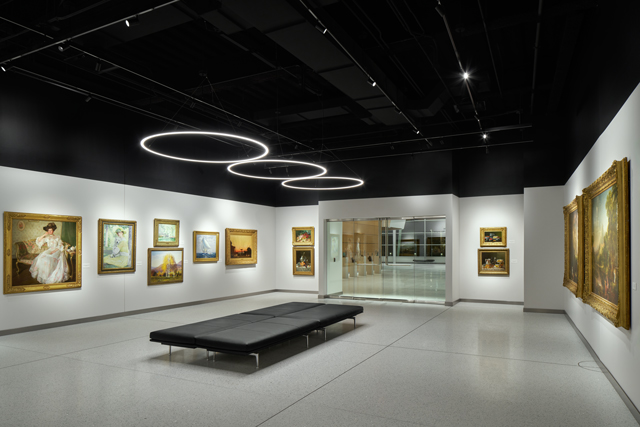
The fine art exhibition space, accessible and enjoyed by all those who enter the lobby, has rotating private art collections. This year the Richard and Jane Manoogian Gallery has several paintings from The Manoogian’s private collection. The community gallery is exhibiting six superb pieces from the Marshall Fredericks Sculpture Museum from the permanent collection of “America’s Public Sculptor,” Marshall M. Fredericks. Both galleries are open to the public - at no cost - June 6, June 13, and June 20 (10am - 2pm). Images courtesy of: Schaap Center
Storm Water System
Dr. Paul Schaap and the Urban Renewal Initiative Foundation contributed $600,000 toward the storm sewer separation project on Jefferson in Grosse Pointe Park. The Center is committed to investment in advanced stormwatermanagement systems like underground detention, bioswales, andsedimentation control.These systems are essential not only for environmental sustainability but also for ensuring the long-term protection of the Schaap Center and more importantly, the surrounding community from flooding.
Gathering Plaza
The gathering plaza provides comfortable bench seating overlooking Jefferson Avenue. The planting beds are filled with native plants and flowers. Brick cobbles are from the historic streetcar public transportation system - cobbles originally paved the streets where the electric streetcars ran as part of the Detroit Public transportation system that began in the early 1860’s with horse-drawn rail cars. It was in the 1890’s that the electric streetcars came into operation. One of the earliest routes was the Jefferson line which ran from the City of Detroit to the border of the of Grosse Pointe Park, where it would terminate at what would later become the Wayburn Loop, where they would turn around and return to Detroit. Part of this piece of land is close to where the Schaap Center is located today.
Some of the cobbles were saved and now take pride of place – a decision taken by Dr. Paul Schaap - to honor and commemorate part of the historic transportation system that was once so integral to the City of Detroit and the historic area where the Schaap Center is located.
SmithGroup
The Schaap Center was designed by Raymond Cekauskas - Architectural Design Leader, with the SmithGroup as the Architect/Engineer of Record. SmithGroup is one of the world’s preeminent integrated design firms, and the longest continuously operating architecture and engineering firm in the United States. Founded in 1853, the company has operated in Michigan since its earliest years.
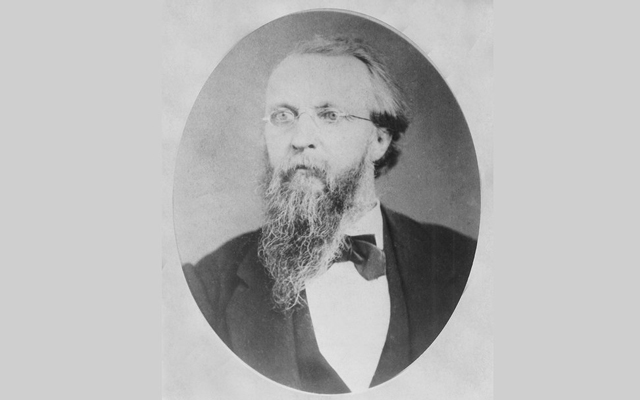
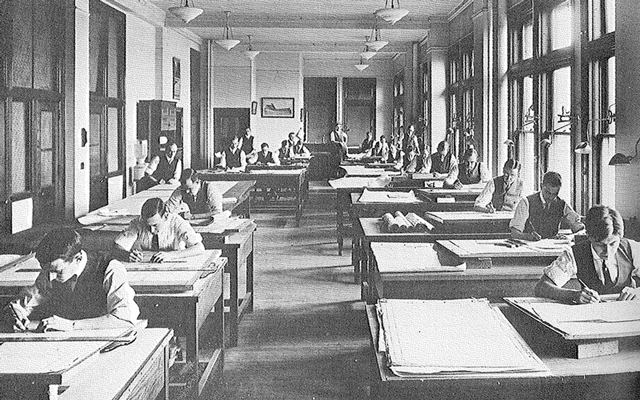
The origins of the company can be traced back to 1853 - the company was established by Sheldon Smith in Ohio. Smith was a self-taught architect who had gained experience with his brother, who was an architect on the east coast. Around 1855, Sheldon Smith moved to Detroit. By 1896, two graduates of the University of Michigan College of Engineering – Theodore H. Hinchman, and Henry G. Field – had joined the firm, utilizing their engineering talents to design many large-scale projects. In 1903, the company was renamed Field, Hinchman, & Smith. At the time, it was understood the firm was adept at “adjusting stylistically to the preference of the client, taking inspiration, and copying from architecture books to design various Classic Revival style structures.” Images courtesy of: smithgroup.com (Sheldon Smith and the SmithGroup drafting room, 1919).
In 1906, Henry G. Field left the firm and H.J Maxwell Grylls joined the company as a partner, which resulted in the firm being renamed Smith, Hinchman, & Grylls. By the end of World War 1, the firm had over 270 staff. During the 1920’s the firm stayed true to its design roots, producing classically inspired architecture throughout Metro Detroit. This included several grand homes in Grosse Pointe along with the Country Club of Detroit (1926-27).
Today the company still exists under the name of SmithGroup. It is now one of the largest architectural and engineering firms in the United States and has a team of 1,600 design experts work across a network of 20 locations throughout the country, including two in Michigan. The firm specializes in designing cultural and higher education institutions, health systems, science and technology organizations, urban environments, workplaces, mixed-use and waterfront developments, and parks and open spaces.
SmithGroup has designed multiple cultural and arts projects for Fair Lane: Home of Henry and Clara Ford, Detroit Institute of Arts, Cranbrook Art Museum, University of Michigan, General Motors, Detroit Zoo, and in Grosse Pointe, the new addition at the Edsel and Eleanor Ford Estate, and of course the Schaap Center.
Thanks for the vision of Dr. Paul Schaap and his late wife Carol, who have donated over $30million to the project, the Schaap Center is an inviting civic destination centered around the arts. As the newest building to be constructed in Grosse Pointe it presents a wonderful modern structure that will become part of the community’s architectural story.
* Photos courtesy of the Higbie Maxon Agney archives unless stated.
** Research, information, and data sources are deemed reliable, but accuracy cannot be fully guaranteed.
Written by Katie Doelle
Copyright © 2026 Higbie Maxon Agney & Katie Doelle
Posted by Kay Agney on
Enjoy this blog post? Click here to subscribe for updates
Leave A Comment