
Last week we featured a prominent, yet unsung builder in Detroit by the name of Emil Schultz. During a career that spanned four decades Schultz built some fine homes in Grosse Pointe in conjunction with noted architects. This included his own home - 719 Berkshire.
This week we travel back to 1776, a very important time in the history of our nation. This historic milestone is something everyone in the country is proud of. So, what was happening in Grosse Pointe at this time?
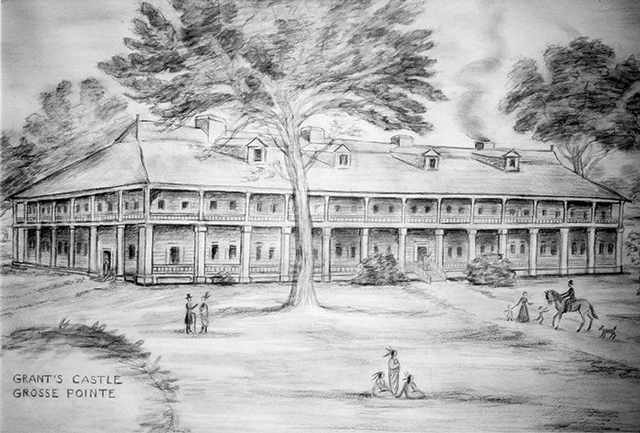
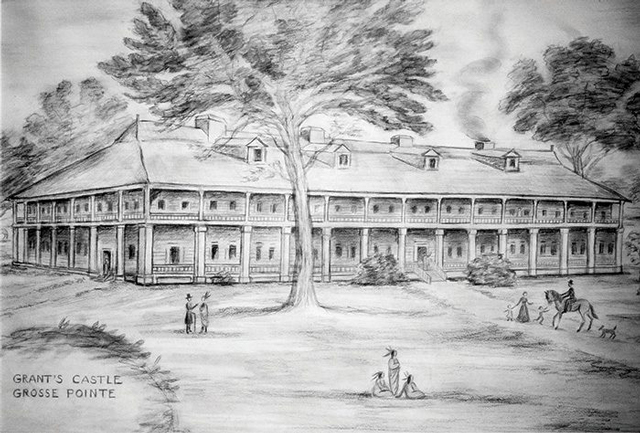
According to the Detroit Historical Society, “in 1776, Detroit was a fortified, British-controlled fur-trading outpost. While the Thirteen Colonies declared independence, Detroit remained under British rule and served as a strategic base for British forces and their Indigenous allies to launch raids into the Ohio Country.” It has been acknowledged British control brought many settlers to the area, including a renowned individual named Alexander Grant – a British Naval Commander of the Great Lakes – who ultimately decided to build a home in Grosse Pointe around 1774-1776. His arrival ensured that he not only became the first prominent settler, but he also constructed the first large permanent residence – “Grants Castle”, located on what is now Lake Shore and Moran in Grosse Pointe Farms.
Commander Alexander Grant was born in Scotland on 20 May 1734. Research states “he was educated by the Navy of Great Britain, but after serving three years he resigned and enlisted as ensign in Montgomery’s Highland Regiment which was being organized for service in America. In 1763, he succeeded to the command of the Naval establishment on all the lakes. Although his military title was that of Captain, he was known as Commodore Grant. After the surrender of Montreal and Quebec to the English he was ordered to lakes Erie and Ontario.”Source: Frank Aubry, Field Writer (1936). Image courtesy of: WikiTree
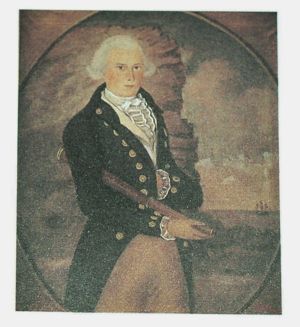
During his career, not only was he a high-ranking naval officer, but he also was briefly involved in the ship building industry, before becoming a prominent politician, in 1805, as the Administrator of the Government of the Province of Upper Canada. 1774, he was 40 years old when he married a young 16 year-old French Catholic girl, Therese Barthe. It is alleged she could not speak English or him French, but the couple had 12 children together (11 daughters and 1 son). Sadly, three of the daughters died at an early age.
The couple settled in Grosse Pointe after Grant purchased a 639-acre farm to build a property known as "Grant's Castle" - completed in 1775/76.Located on Lake Shore and the corner of what is now Moran Road, it allegedly had a frontage of nine acres on the Lake and a depth of seventy-one acres. The property was said to have had fine gardens and orchards. It is understood the farm is also significant as “embracing the first "cleared" land in Grosse Pointe.” It is understood the property originally extended from the present St. Paul on the Lake Catholic Church to the grounds of the former George V. N Lothrop estate – 215 Lake Shore, built by George Lothrop in 1847 - which originally stood at the northeast corner of Grant’s farm.
Prior to purchasing the land, Commander Grant, “in aspiring to find a seigneury similar to the old French claims on the St. Lawrence, selected the tract of land, and during the winter, when the lakes were frozen, he employed his sailors and soldiers in clearing of the forest trees. The house was built of hewn oaken timbers taken from the trees in the surrounding forest that had been cut down. These were neatly dovetailed at the corners, and the interstices between the logs carefully filled with plaster. It was about 160 feet long, two stories in height, and surrounded, on all sides by huge two-story verandas or "galleries," as the French termed them, and, in shape, resembled a great barrack.” It is alleged the large house was the location of much entertaining and lavish parties, some of which were supposedly to introduce his beautiful daughters to society. It has also been suggested that many people regard Alexander Grant as the founder of the Grosse Pointes. Source: Grosse Pointe on Lake Sainte Claire, published by Silas Farmer & Co. (1886). Image courtesy of: GP Historical Society
Several years later, it is understood “President Madison signed the land patent giving Alexander Grant the title to his Grosse Pointe Farms estate only one day before the declaration of war with Great Britain on June 18th, 1812.” Commodore Alexander Grant resided at his “castle” until his death on 8 May 1813 (his wife had passed in the spring of 1811). “Three days later he was buried in St. Johns Churchyard in Sandwich, Ontario. On the wall of the church may be seen a tablet, erected by one of his grandsons, as a tribute to his memory. The accounts of his estate may also still be seen. It recited that fifteen shillings were paid to three men for going to Grosse Pointe in a canoe to collect Grant’s corpse.” Source: Frank Aubry, Field Writer (1936)
Alexander Grant’s estate was divided equally among his children (the last of whom, Jane, died in April 1875). It is understood "Grant's Castle" and part of the property on which It was situated, were then purchased in 1825 by Louis Moran, Sr., who deeded the property to his son George and his daughter, Monique Campau. With limited and somewhat conflicting details, it appears the “castle” was purchased by Theodore Parsons Hall, around 1875. It is understood the house was razed around this time, and the land subdivided. It is reported Mr. Hall used an old walnut staircase, mantelpiece and doors from the original structure for his new mansion called "Tonnancour" (completed in 1880). Source: Heritage Magazine (February 1986).
Parts of the original Grant property became the location of Grosse Pointe Academy, the unfinished John Dodge mansion (223 Lake Shore – started in 1918 and razed in 1941), while the rest of the estate was eventually filled with many fine residential properties we know today.
* Photos courtesy of the Higbie Maxon Agney archives unless stated.
** Research, information, and data sources are deemed reliable, but accuracy cannot be fully guaranteed.
Written by Katie Doelle
Copyright © 2026 Higbie Maxon Agney & Katie Doelle
Posted by Kay Agney on
Enjoy this blog post? Click here to subscribe for updates
Leave A Comment