
Last week we began a two-part series on the work of D. Allen Wright, one of the most versatile designers to work in Grosse Pointe. He designed close to 30 homes in the community including some of the finest examples of French inspired residences in the area.
This week we continue the story of David Allen Wright with some of the projects he completed post 1930. It was during this phase of his career that he transitioned from creating his French inspired homes of the late 1920’s, into a designer that focused on more modern style residences that were growing in popularity across the United States, including several state of the art homes.
During the 1930’s Wright’s approach began to change considerably. Many of the homes he was designing were starting to display characteristics of modern architecture, primarily the International style, that was fast gaining popularity throughout Europe and America, thanks to the growing influence of the Bauhaus in Germany. The International style is an important architectural movement that began in 1923. It began to gather pace in the US at the beginning of the 1930’s, with many US cities on the East Coast utilizing the change in building materials to build commercial buildings, including skyscrapers, led by pioneering architects in this era such as Philip Johnson. At the same time groundbreaking residential projects were being created by Frank Lloyd Wright and Eliel Saarinen to name but a few.
The most common characteristics of International style buildings/homes are rectilinear forms, huge amounts of natural light, open interior spaces, and taut plain surfaces that have been completely stripped of applied ornamentation and decoration. Many homes created in this style also had geometric simplicity, a low roof with windows flush to the wall surface.
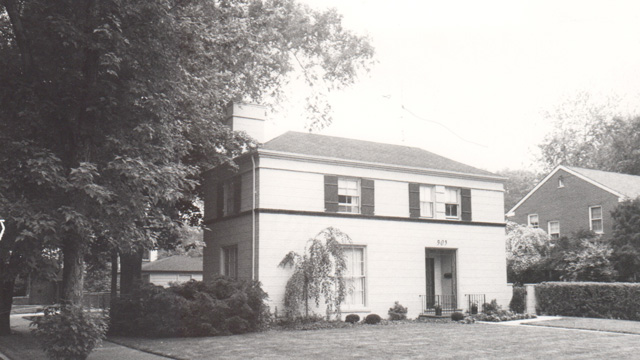
Two homes designed by D. Allen Wright in Grosse Pointe in the International style are:
905 Lakepointe - Grosse Pointe Park, 1937 – for Richard O'Brien.
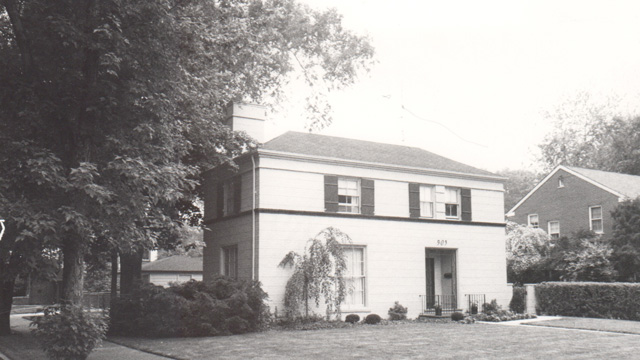
846 Grand Marais - Grosse Pointe Park – 1937 - for the Liberty Starter Company.

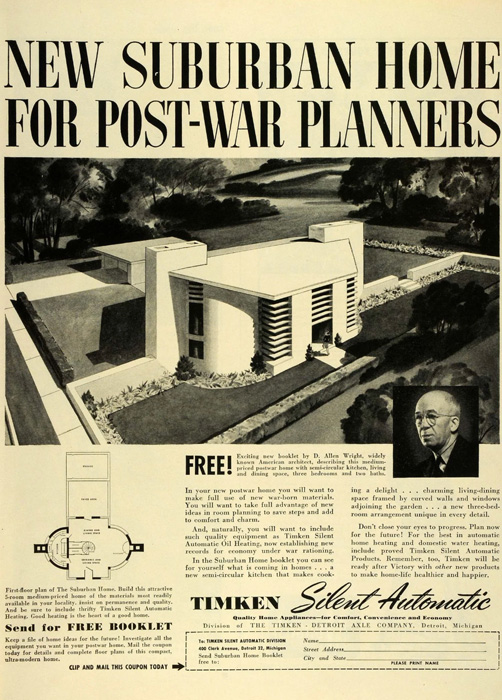
By the early 1940’s Wright was a nationally recognized architect, specializing in medium priced state of the art homes. In a booklet produced in conjunction with Timken, a division of the Detroit Axle Company, it is apparent Wright was instrumental in designing a modern innovative home complete with a semi-circular kitchen, and a living-dining space, framed by curved walls and windows. Below is a copy of a print ad from the booklet. Image courtesy of: periodpaper.com
It was reported Mr. Wrights post war plans were “homes to meet the 30-billion-dollar demand of tomorrow.” The article explained “Wight planed on making full use of the new “miracle” materials and construction methods. They would be permanent yet flexible, so they could be enlarged to meet growing family needs with partitions that could be moved at will to make one room larger, or another smaller. They would combine privacy with plenty of light and living space and would contain conveniences unknown in the past. They would save steps, save work – and above all, save upkeep cost.”
The plan by Wright for the ‘multi-unit house’ was a home that could be built complete at one time, or in various stages. For example:
- Stage 1 - start with the center unit that would contain the living room, sleeping quarters, kitchen and bath…a cozy modern home that could be quickly and easily expanded later.
- Stage 2 - to be designed to include any combination of rooms…with a car shelter built over the driveway.
- Stage 3 – would provide separate guest quarters or extra space for the family. Each unit would have independent individualized Timken automatic heating.


Wright also developed a project called the ‘Victory Home’. It was reported it would be mass-produced for low-income families, intended to have walls that wouldn’t crack, doors that wouldn’t swell, life-time interior finishes, and double-glazed windows to maximize the progress in heating and air conditioning. Floors were warmed by hot pipes.
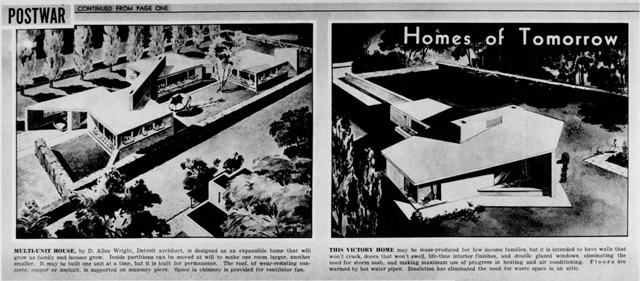
Source and images: Detroit Free Press (June 1943).
David Allen Wright had a rich and varied career. From master designer of French architecture to creating innovative homes for the future. One could say he transitioned his approach more significantly than most.
* Photos courtesy of the Higbie Maxon Agney archives unless stated.
** Research, information, and data sources are deemed reliable, but accuracy cannot be fully guaranteed.
Written by Katie Doelle
Copyright © 2026 Higbie Maxon Agney & Katie Doelle
Posted by Kay Agney on
Enjoy this blog post? Click here to subscribe for updates
Leave A Comment